



Tax-Aware Investing – Has Anyone Done the Math?
This is an excerpt from a Bloomberg News article on 23 December 2025:
JPMorgan Asset Management is tapping into a booming market for wealthy investors with the launch of a private fund designed to maximize after-tax returns by generating losses. The J.P. Morgan Tax-Smart Disciplined Equity Long Short Strategy is said to take bullish positions in a basket of stocks while also betting against certain companies. The shorted names will ideally produce losses that the fund can then harvest to offset capital gains.
So-called tax-aware investing is quickly becoming one of the hottest trends in wealth management as the affluent seek to reduce their tax bills. A long-running bull market in US stocks has left many investors with massive unrealized gains and concentrated positions in specific names. Taking short positions to create losses which can then be used to offset gains elsewhere in the portfolio should theoretically lower an investor’s tax burden when the time comes to sell appreciated assets. —David E. Rovella
Our first question is, has anyone done the math?
A loss, is a loss, is a loss. What is appealing about losing money in one account in order to offset gains in another account?
The only way to offset the gain is to lose the equivalent amount of money. Our goal is to earn money, not lose it.
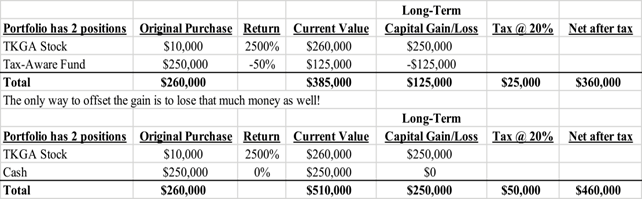
Here is the math comparing two theoretical portfolios:
Source: Archer Bay Capital LLC
Each portfolio has highly appreciated stock – TKGA stock (not a real company) has returned 2500% and the value is composed mostly of gains.
In the first portfolio, the investor also has a Tax-Aware fund that is designed to lose money in order to use those losses to offset the gains in TKGA. This does reduce the tax liability for the appreciated stock, but the investor is actually worse off than if the taxes were paid because of the money lost in the Tax-Aware fund.
To put a finer point on this, the Tax-Aware fund is designed to lose money to offset the other capital gains. The portfolio manager is “successful” if that they lose 50% of the value of the account. This has reduced the investor’s capital gains by the amount of the loss. The value of the account after the sales of both positions would be $360,000.
In the second portfolio, the investor decided to just hold cash instead of buying the Tax-Aware fund. This investor pays taxes on the entire taxable gain for TKGA stock. There was no loss (or gain) on the cash sitting in their account. The value of this account after the sale of TKGA stock AFTER paying 20% capital gains tax is $460,000.
If the Tax-Aware fund perfectly matches losses and gains, the investor does avoid paying taxes, but the end result is a worse absolute outcome. The fund manager benefits by selling another product and earning fees, regardless of the outcome.
We believe that the whole purpose of investing is to make money. Some people REALLY hate to pay taxes and that’s fine. However, it is important to do the math to determine if the investor is truly better off, or not.
P.S. The Bloomberg article also discusses using a concentrated stock position as margin collateral to buy a diversified stock portfolio to offset the volatility of a single stock. This is a separate strategy than tax-aware investing and can be used in conjunction with it. But losses in either portfolio are just one-to-one offsets to the taxes.
** Not tax advice.