


War in the Middle East and the Markets
When we analyze geopolitical events and the potential effect on the financial markets, we focus on how corporate earnings will ultimately be impacted. For conflicts in the Middle East, the biggest potential for disruption is obviously the oil markets.
The Balance Between Supply and Demand
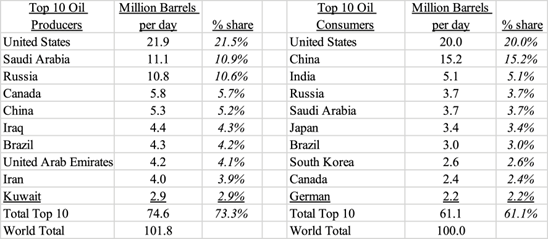
First, let’s start with a list of the top ten oil producers and oil consumers.
Source: US Energy Information Agency, April 2024
Five of the top ten producers are located in the Middle East (Saudi Arabia, Iraq, United Arab Emirates, Iran, and Kuwait). Four of the top ten consumers are located in Asia (China, India, Japan, and South Korea). Shipping oil between the Middle East and Asia is key to a well-functioning market.
Geography Matters
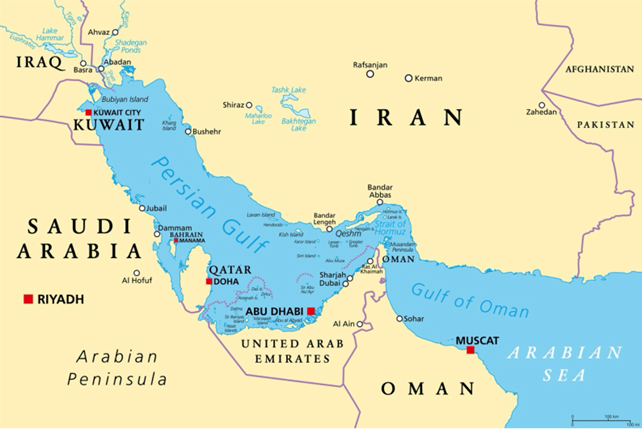
On the map below it is easy to see the bottleneck structure of the Straits of Hormuz. It is where the Persian Gulf and the Arabian Sea connect, between Oman and Iran, through which the oil from the Persian Gulf needs to travel.
Source: iStock credit: PeterHermesFurian
Roughly 25% of oil transported globally needs to go through the Straits. They are geographically vulnerable and can be easily attacked in multiple ways, including by using drones.
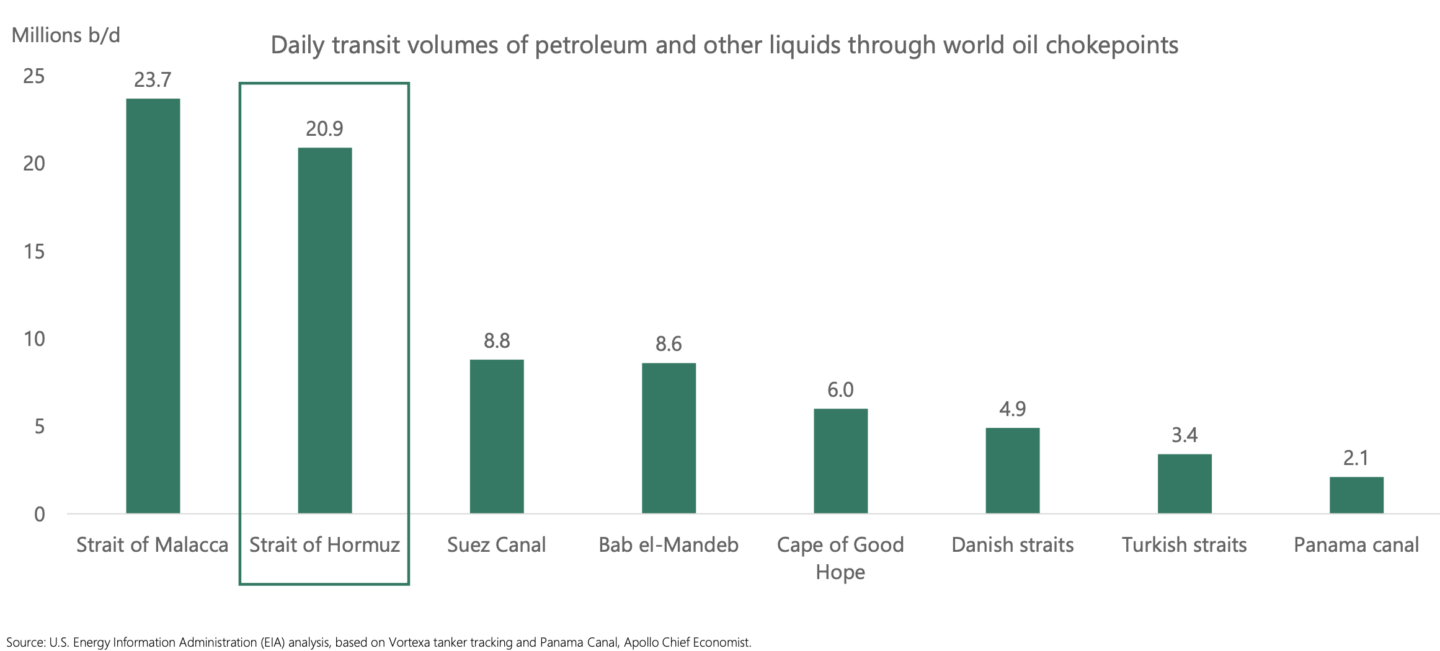
The importance of oil to the overall economy is high but it is different than it was in the 1970s, when we also had major oil disruptions. Today, the major oil consuming countries hold excess petroleum inventory in national strategic reserves in case of dislocations such as this. This makes us less concerned about manufacturers shutting down or electricity not being generated in the near term; the risk is more about timing.
It would be logical for producers to be reluctant to send shipments and risk attack rather than hold back and wait for fighting to stop. The big unknown is how long that will take for the conflict to resolve. The longer the fighting lasts, the greater the chance that producers run out of places to store the unshipped oil, and the greater the risk that strategic reserves get depleted.
Oil Prices and Inflation
Current oil price is roughly $92 a barrel. The peak was over $140 in 2008.
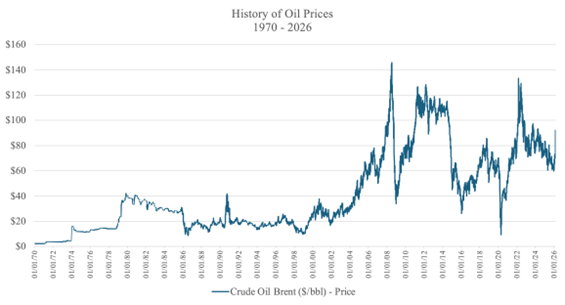
Source: FactSet Research System; Archer Bay Capital LLC
Markets hate uncertainty and it is reflected in higher oil prices now. If the conflict resolves quickly, prices should settle back down soon. If it doesn’t resolve quickly, then it may take some time for governments and businesses to find alternative ways to transport oil and to find alternatives to oil energy where possible.
Inflation can impact corporate earnings negatively, but not in all cases. Higher oil prices raise costs for manufacturers but, as we have seen in the past several years, higher costs can frequently be passed along to the consumer so that businesses maintain their margins.
We believe that part of corporate earnings growth over the past year is directly related to the higher revenue growth coming from increased prices for goods and services. Businesses pass along inflationary costs when they can. The spike in oil prices can be absorbed for a while, but if lasts for an extended period, neither businesses nor consumers (nor the Federal Reserve) will get the inflation relief they seek.
[This blog is strictly covering the immediate economic impacts of the oil market disruption and is not intended to make any inference related to the human cost of war.]